
Table of Contents
- The Case Study in One Line
- The Numbers That Matter
- What "Value per Person" Actually Means
- The Before: A Familiar Support Problem
- Why Slow Replies Become Missed Revenue
- The Turning Point: This Was Not "Let's Add AI"
- The Three Guardrails That Made High Automation Safe
- Why the Results Were Not "AI Magic"
- What This Means for Service Businesses
- Where Unplain Media Fits
- A Simple Question for Your Business
- The Bigger SEO and AEO Lesson
- What This Can Do for Your Business
- Want to See What This Would Feel Like in Your Business?
- FAQ
A customer does not usually announce they are leaving.
They do not send a dramatic farewell message.
They do not say, "Dear business, I am now taking my money elsewhere because your response time disappointed me."
They simply stop trying.
They call once while your team is busy.
They send a WhatsApp message and wait.
They open your website chat, type "hello," stare at the screen for 40 seconds, and close it.
Then they go to the competitor who replies like a machine.
Because sometimes, it is a machine.
Most businesses do not lose customers because they are terrible. They lose customers because they are slow at the exact wrong moment.
And the painful part is this: the work that makes them slow is often not strategic, creative, emotional, or complex.
It is copy. Paste. Template. Repeat.
A human being, sitting on payroll, used as an expensive keyboard.
This case study exists to prove one thing: support speed and operational efficiency are not personality traits. They are design choices.
At Unplain Media, this is exactly the type of problem we help service businesses solve with AI chat agents, AI voice agents, booking automation, CRM automation, workflow automation, and better customer communication systems.
Before reading the full story, you can test the feeling for yourself. Try an AI chatbot or voice agent on your own business and ask it the questions your customers ask every day. You will quickly notice the difference between "we will get back to you" and "handled instantly."
Now, the proof.
The Case Study in One Line
This is an anonymized enterprise transformation drawn from Tony Jacobs' professional experience leading customer operations in a multinational environment with more than 1,000 employees, dozens of brands, and high customer lifetime value.
No customer satisfaction or churn metrics are included here by choice.
This story is about operational physics: the kind of customer communication improvement you can measure without debating dashboards.
The Numbers That Matter
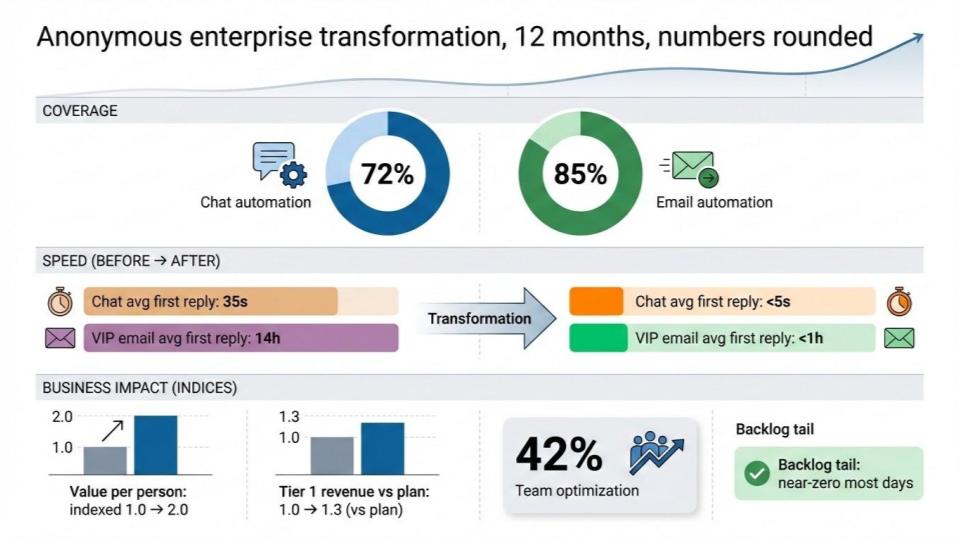
For readers who prefer evidence before storytelling, here is the transformation in plain numbers:
- Chat automation coverage reached 72%.
- Email automation coverage reached 85%.
- Average chat first response time moved from around 35 seconds to under 5 seconds.
- Average VIP email first response time moved from around 14 hours to under 1 hour.
- The backlog "tail" became near-zero most days, leaving only normal day-to-day volume.
- The support organization was optimized by 42%.
- Tier 1, the highest-spend customer segment, delivered 30% revenue above plan.
- Value per person doubled.
These numbers matter because they show something deeper than "AI answered some messages."
They show what happens when customer support automation is treated as an operating system, not as a gimmick.
What "Value per Person" Actually Means
Value per person does not mean tickets per agent.
That would be too simple and, frankly, too dangerous.
A team can answer more tickets while still failing commercially. They can be busy, efficient, and completely misaligned with business value.
In this case, value per person meant profitability-weighted retention value per agent.
In plain English: the business looked at the profitability of customers retained per agent, not just the raw number of support requests handled.
That distinction matters.
Because the goal of customer communication automation is not to make people look busy.
The goal is to protect revenue, reduce waste, improve speed, and make sure human attention is spent where it actually creates value.
This is also how service businesses should think about AI automation. Whether you run a clinic, salon, hotel, dealership, dental practice, veterinary clinic, real estate office, or local service company, the real question is not "Can AI reply?"
The better question is:
Can AI help your business stop leaking opportunities?
The Before: A Familiar Support Problem
The support team grew.
Then the backlog grew faster.
At first, it looked manageable. A few extra unanswered messages. A few delayed replies. A few emails waiting longer than they should.
Then the "tail" appeared.
A tail is what happens when old customer requests never fully disappear. New requests arrive every day, but yesterday's unresolved work is still sitting there. Then last week's work joins it. Then VIP customers start waiting. Then managers begin asking why the team is working hard but the queue still feels stuck.
That is when customer communication becomes operational quicksand.
The team was not lazy.
The team was not careless.
The system was badly shaped.
A large share of the queue was not complex problem-solving. It was repetitive manual work:
- The same answers.
- The same clarifications.
- The same routing decisions.
- The same template responses.
- The same commercial proposal and spam housekeeping.
- The same internal "who should handle this?" questions.
And once a business reaches that stage, hiring more people starts to become an expensive way of protecting a broken process.
Hiring can help.
But hiring cannot be the strategy forever.
At some point, the system has to change.
Why Slow Replies Become Missed Revenue
For service businesses, slow replies are not just a customer service issue.
They are a revenue issue.
A missed call can become a missed booking.
A missed WhatsApp message can become a lost consultation.
A slow website chat can become a competitor's new customer.
An after-hours enquiry can become revenue for the business that had an AI voice agent or chatbot ready when the human team had gone home.
This is why AI customer communication automation is becoming important for local businesses and service businesses. The customer does not care whether the delay came from understaffing, bad routing, manual admin, or an overloaded inbox.
They only experience one thing: Nobody helped me when I was ready.
That moment is where revenue leaks.
And that is where automation can be designed to help.
The Turning Point: This Was Not "Let's Add AI"
The breakthrough did not come from saying, "Let's add a chatbot."
That is where many businesses go wrong.
They bolt AI onto a messy process and expect magic.
But automation does not fix chaos. It scales whatever system you attach it to.
If the process is unclear, AI makes the confusion faster.
If the routing is weak, AI sends customers to the wrong place faster.
If escalation rules are missing, AI creates risk faster.
The actual transformation came from redesigning the support operating system.
Four decisions did most of the heavy lifting.
1. One VIP Rule, Enforced Without Drama
Priority support often sounds good in presentations and fails in practice.
Everyone agrees that high-value customers should be treated differently.
Then daily reality arrives.
A VIP message lands in the same queue as everything else. A manager says, "Please keep an eye on these." Someone creates a label. Someone else forgets the label exists. The team tries its best. The customer still waits.
In this transformation, the rule was simple.
Tier 1 customers, the highest-spend segment, received a dedicated queue and a 1-minute target response.
That was it.
One rule.
Clear. Measurable. Enforced.
No vague "premium experience" language. No complicated internal politics. No "we will try."
The queue was redesigned around the customer's value to the business.
That single decision made priority support real.
For service businesses, the same principle applies. Your highest-value customers, hottest leads, urgent enquiries, and booking-ready prospects should not be treated like random inbox items.
AI routing, CRM automation, and workflow automation can help identify those requests and move them to the right place faster.
2. Email Automation Became the Silent Backlog Killer
Email is where support problems hide.
A missed call feels urgent.
A live chat feels urgent.
A WhatsApp message feels personal.
Email feels patient.
Until it is not.
Email backlogs quietly damage trust because they make the business feel unreliable. Customers may not complain immediately, but they remember the silence.
In this case, email automation tackled the repetitive work first.
It helped with standard outputs, classification, routing, and faster first replies without forcing every request through a human bottleneck.
That may not sound glamorous.
But it is exactly how you stop the slow bleed.
A strong AI automation agency should not only build flashy front-end chatbots. It should also understand the hidden operational layers: inboxes, CRM fields, routing logic, internal workflows, follow-ups, and escalation paths.
That is where the real gains often live.
3. Chat Automation Was Built to Finish the Job
Many chatbots are not built to resolve problems.
They are built to deflect them.
The customer asks a question. The bot misunderstands. The customer rephrases. The bot gives a generic answer. The customer clicks away, now slightly more irritated than before.
That is not automation.
That is a digital obstacle.
In this transformation, chat automation was designed around carefully chosen categories: high-volume, repetitive, predictable, and safe with guardrails.
The automated categories included general FAQs about products and services, subscription changes, profile and content moderation appeals, commercial proposals, and inbound spam.
These were deployed as full automation flows with strict escalation boundaries.
That part is critical.
Good AI chat agents should not try to answer everything. They should confidently handle what they are designed to handle, and quickly hand off what requires human judgment.
That is how automation becomes useful instead of annoying.
4. Routing Started Behaving Like a Brain, Not a Bucket
Automation without routing is like hiring more people and still letting every customer walk into the wrong room.
The old model was too bucket-based.
A request came in. It entered a queue. Someone eventually looked at it. Then it moved somewhere else. Then someone else handled it. Maybe.
The redesigned model used intent classification, tier logic, and risk flags.
Requests were routed by intent into specialist queues such as subscription and billing, moderation, and general support.
Tier 1 customers received the fast path.
Risk triggers bypassed automation and went directly to a human.
This is where AI becomes more than a chatbot.
It becomes customer communication infrastructure.
For local businesses, the same logic can apply to missed calls, website chats, Facebook messages, Instagram DMs, WhatsApp enquiries, booking requests, quote requests, and after-hours enquiries.
A good system does not just reply.
It understands what the customer is trying to do, qualifies the request, updates the CRM, triggers the right workflow, and helps the business respond with speed and control.
The Three Guardrails That Made High Automation Safe
When people hear "end-to-end automation," their first fear is reasonable.
What happens when it is wrong?
That question should not be dismissed. It should be designed around.
In this transformation, three guardrails made scale possible without becoming reckless.
Hard Escalation Rules
Certain keywords, risk flags, VIP triggers, and sensitive scenarios forced a handoff to a human.
The system was not allowed to improvise beyond its boundaries.
QA Sampling
Automated conversations and decisions were reviewed through daily and weekly checks.
This was not based on vibes.
The team reviewed what was automated, what escalated, what failed, and what needed adjustment.
A Formal Do-Not-Answer List
Some topics were not suitable for automation.
When a request touched those boundaries, the answer was simple: human, every time.
These guardrails did not slow automation down.
They made automation safe enough to grow.
That is a major lesson for any business considering AI voice agents, AI chat agents, or customer support automation. The goal is not maximum automation at any cost.
The goal is controlled automation that improves speed without creating unnecessary risk.
Why the Results Were Not "AI Magic"
Here is the real secret.
The win was not only that customers got faster answers.
The bigger win was that the organization stopped wasting human attention on work that did not deserve it.
When repetitive work disappears, humans stop acting like copy-paste engines.
Specialist time becomes protected.
Priority customers get predictable service.
Managers stop drowning in queue anxiety.
And value per person can actually improve because the system stops leaking profitability through delay.
That is how response time collapses.
That is how backlog tails disappear.
That is how a support organization can be optimized by 42% without the service collapsing.
Not heroics.
Architecture.
What This Means for Service Businesses
This case study came from an enterprise environment, but the mechanics apply directly to smaller service businesses.
A beauty clinic may not have a huge support department, but it still has missed calls, booking questions, treatment enquiries, Instagram messages, and after-hours leads.
A hotel may not call it "support automation," but it still deals with room enquiries, booking questions, late-night guest messages, upsell opportunities, and multilingual communication.
A car dealership may not think it needs an AI agent, but it still misses test-drive requests, finance questions, trade-in enquiries, and weekend leads.
A dental clinic may not have a backlog dashboard, but it still loses patients when nobody answers quickly enough.
The scale changes.
The physics do not.
If customers contact your business through calls, website chat, WhatsApp, email, social media, forms, booking pages, or Google Business Profile, then your customer communication system either captures demand or lets it leak.
That is the commercial opportunity behind AI automation for service businesses.
Where Unplain Media Fits
Unplain Media helps service businesses design practical AI systems around real commercial problems.
Not "AI for the sake of AI."
- AI for missed calls.
- AI for missed messages.
- AI for after-hours enquiries.
- AI for booking automation.
- AI for lead qualification.
- AI for CRM updates.
- AI for follow-ups.
- AI for customer support automation.
- AI for local SEO, AEO, structured content, and AI search visibility.
The point is not to replace the human side of your business. The point is to protect it.
Humans should handle judgment, trust, nuance, relationships, exceptions, and sales conversations that deserve real attention.
AI should handle the repetitive, immediate, predictable, and easily structured work that currently slows everyone down.
That is the balance.
A Simple Question for Your Business
Here is a useful test.
Look at your last 100 customer enquiries.
How many were genuinely complex?
How many needed a senior human?
How many were booking questions, opening-hours questions, pricing questions, availability questions, quote requests, follow-ups, reminders, repeated FAQs, or "can someone call me back?" messages?
If a meaningful percentage of those enquiries were repetitive, your business may not have a staffing problem.
It may have a system design problem.
A chatbot, voice agent, booking automation, or CRM workflow will not solve everything.
But it may solve the exact part of the work that is making your team slow.
If you want to see where that line is in your own business, Unplain Media can run a missed-opportunity audit and identify what should be automated, what should stay human, and what a realistic first rollout should look like.
The Bigger SEO and AEO Lesson
There is another layer to this story.
The businesses that win with AI will not only respond faster.
They will also become easier to find.
That is where local SEO, AEO, schema, structured content, and AI search visibility matter.
When customers search on Google, ask ChatGPT, use Gemini, compare options in Perplexity, or look for "the best clinic near me" or "AI agency for service businesses," search engines and answer engines need clear information about what your business does.
Unplain Media approaches visibility as part of the same commercial system.
Because being found matters.
But being found and failing to respond is still a leak.
The stronger play is to connect visibility, customer communication, automation, and follow-up into one system.
Search brings the opportunity in.
AI agents and automation help make sure the opportunity is not wasted.
What This Can Do for Your Business
If your business depends on customer communication, this case study is not enterprise theatre.
It is a mirror.
The same playbook can help service businesses respond faster, reduce repetitive work, protect high-value customers, improve booking capture, qualify leads, update CRMs, trigger follow-ups, and turn customer communication into measurable performance instead of daily firefighting.
You do not need enterprise scale to start.
You need the willingness to design the system instead of feeding it more people.
Want to See What This Would Feel Like in Your Business?
Reading helps.
Experiencing is faster.
On the Unplain Media website, you can test an AI chatbot or voice agent and simulate how it would respond to your most common questions, booking requests, quote enquiries, and messy real-world customer wording.
Or, if you want a more precise view, request a missed-opportunity audit.
We can look at where customers are trying to reach you, where requests get stuck, what is repetitive enough to automate safely, what should stay human, and what a practical Phase 1 rollout could look like.
No hype.
Just measurable outcomes.
FAQ
What is AI customer support automation?
AI customer support automation uses AI chat agents, voice agents, routing logic, CRM workflows, and escalation rules to handle repetitive customer enquiries faster while sending complex or sensitive cases to humans.
What does 72% chat automation coverage mean?
It means about 72% of incoming chats were handled without requiring a human response, using end-to-end automation flows and clear escalation rules.
What does 85% email automation mean?
It means about 85% of inbound email handling was automated through classification, routing, standard responses, and controlled resolution flows with do-not-answer boundaries.
Can AI automation help small service businesses?
Yes. The same logic applies to clinics, salons, hotels, car dealerships, dentists, veterinary clinics, real estate companies, and other local businesses. The goal is to automate repetitive enquiries, capture missed opportunities, and protect human attention for higher-value work.
Can AI voice agents help with missed calls?
Yes. AI voice agents can answer common questions, capture booking requests, qualify leads, collect details, and support after-hours enquiries when the human team is unavailable.
Is customer support automation risky?
It can be risky if implemented without guardrails. Safe automation needs escalation rules, QA sampling, do-not-answer boundaries, and clear rules for when a human must take over.
What is the difference between an AI chatbot and a proper AI chat agent?
A basic chatbot often answers simple FAQs. A proper AI chat agent can understand intent, guide the customer, qualify the request, trigger workflows, update the CRM, and escalate when needed.
How does this connect to local SEO and AEO?
Local SEO and AEO help customers and AI search engines understand what your business offers. AI agents and automation then help capture and handle the enquiries that visibility creates.
What does Unplain Media do?
Unplain Media is a Cyprus-based AI agency for service businesses. It builds AI voice agents, AI chat agents, customer communication automation, booking automation, CRM workflows, lead qualification systems, and AI search visibility improvements.
Tony Jacobs
Tony is a family man and product-led revenue strategist focused on turning customer communication, visibility, and follow-up into measurable business growth.